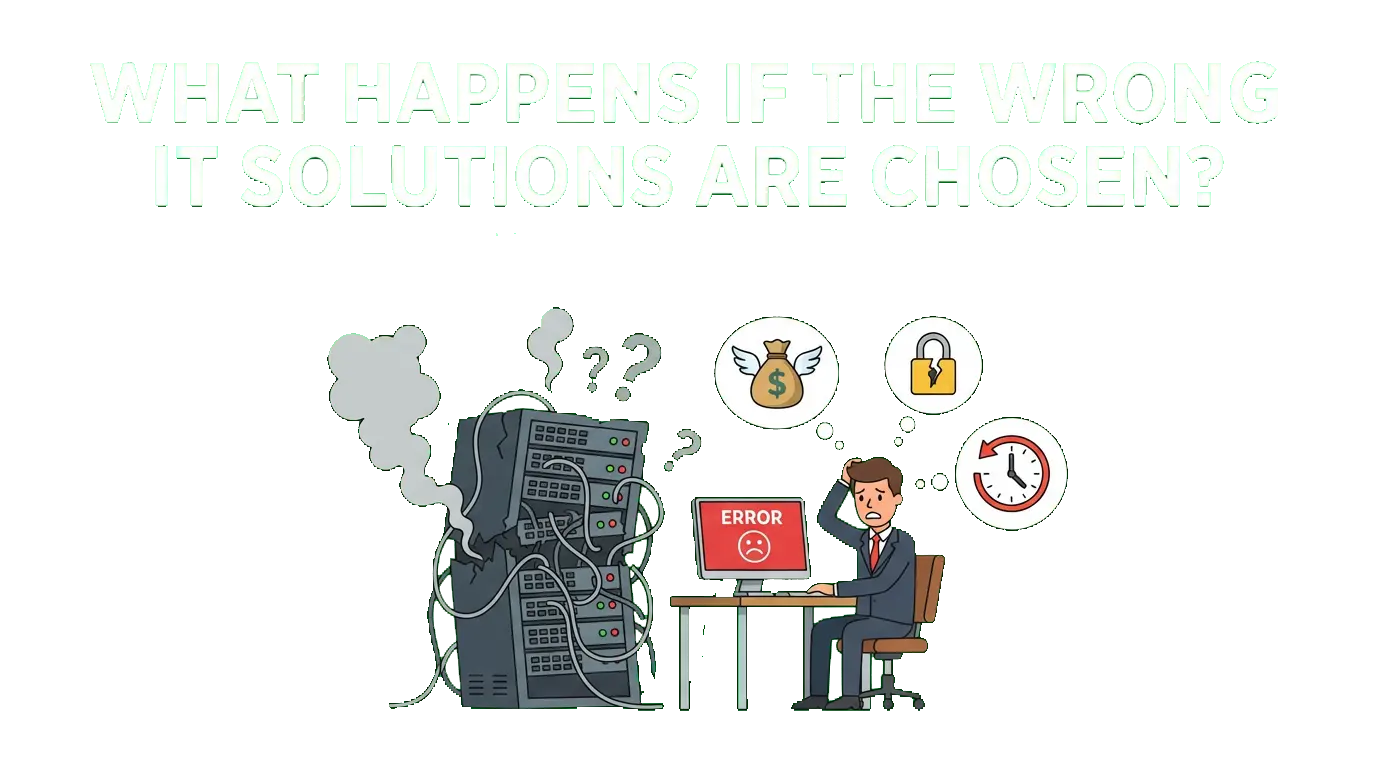
What Happens If IT Solutions Are Chosen Incorrectly?
An IT project usually starts like this: “we need a new CRM,” “the ERP must be changed,” “we need to build a faster system.” But the main question is often not asked: why?
If requirements (business needs, process mapping, user roles, integration needs) are not clearly defined, the chosen IT solutions may present an impressive “demo,” yet get stuck in the real working environment. The result? The system exists, but the work does not become easier.
This situation is especially visible in rapidly growing companies: it “manages” today, but “strangles” tomorrow.

Consequences: Time, Money, and “Half-Finished” Projects
Incorrect IT solutions usually hit the budget and timeline first. The most dangerous part here is the “hidden costs.”
After some time, scenarios like the following emerge: - the need to purchase additional modules, - licenses turning out to be more expensive than expected, - additional team or vendor costs for integration, - parallel work with the old system (double operations).
As the project drags on, employees become exhausted, the business side feels “it’s delayed again,” and management pauses the next step because it does not see results. In the worst-case scenario, the system remains unfinished, but the expenses have already been incurred.
Security and Trust: The Most Expensive Risk
A technical selection mistake is sometimes not just an inconvenience, but a risk. Incorrect IT solutions may create the following gaps: - weak role and permission management, - incomplete audit trails, - unclear backup and recovery plans, - dependency on outdated components.
This means that when an incident occurs, the problem is not only that “the system is down.” Customer trust, financial loss, and even legal risks may come into play. Security is not a “feature” added later; it must be part of the selection.
People and Process: When Adoption Fails, the System Fails Too
Even the most powerful platform does not deliver efficiency if it is not adopted by users. Incorrect IT solutions are often purchased without testing “ease of use,” and then this happens: - employees bypass the process, - information becomes fragmented across different places, - unofficial tools increase (messaging groups, personal files, Excel sheets).
There is also the issue of vendor dependency. The system is built in such a way that changing the vendor becomes expensive and difficult. This reduces flexibility in the future: as the company grows, instead of meeting new needs, the question becomes “how can we somehow adapt the existing system?”

Correct IT Solutions vs. Incorrect IT Solutions: A Brief Comparison
|
Area |
Correct IT Solutions |
Incorrect IT Solutions |
|
Budget and timeline |
phased implementation, transparent costs, realistic plan |
hidden costs, extended deadlines, incomplete results |
|
Integration and data |
predefined integration plan, unified data rules |
“manual” connections, duplicated data, analytical confusion |
|
Security |
role/IAM, audit, backup and recovery scenario ready |
gaps, incident risk, reputational damage |
|
Scalability and flexibility |
as the business grows, the system grows |
performance declines, changes become expensive, vendor dependency increases |
What Should Be Done in the Azerbaijani Context?
In Azerbaijan, the options for selecting IT solutions are broad: local integrators, foreign platforms, ready-made industry systems, and both cloud and on-prem approaches are available. Nevertheless, the precise market share distribution and open statistics on “which sector has adopted what and to what extent” are often not clearly presented — therefore, tying the decision more to needs than to numbers is a healthier approach.
As a practical step, especially for local organizations, three topics are critical: local support, data storage requirements/conditions within the country, and integration capability. In a tender or selection process, not only price but also these three pillars should be evaluated.
For a quick review, here are short “quick tips”: - Write the requirements in a 1-page “problem + goal + KPI” format. - Run a pilot (4–8 weeks) and do not enter a large contract without measuring the results. - Make sure to include data export (exit plan) and SLA in the contract. - Review the security and permission model at the beginning of the selection. - Plan user training at the “start,” not at the “end,” of the project.
Choosing the right IT solutions shortens time, reduces risk, and prepares the business for growth; incorrect IT solutions inflate costs and slow down processes. For decision-makers, the best path is to clarify the requirement, validate it with a pilot, and only then decide on scaling. This approach protects both the budget and the organization’s credibility.