Does Small Business Need an ERP?
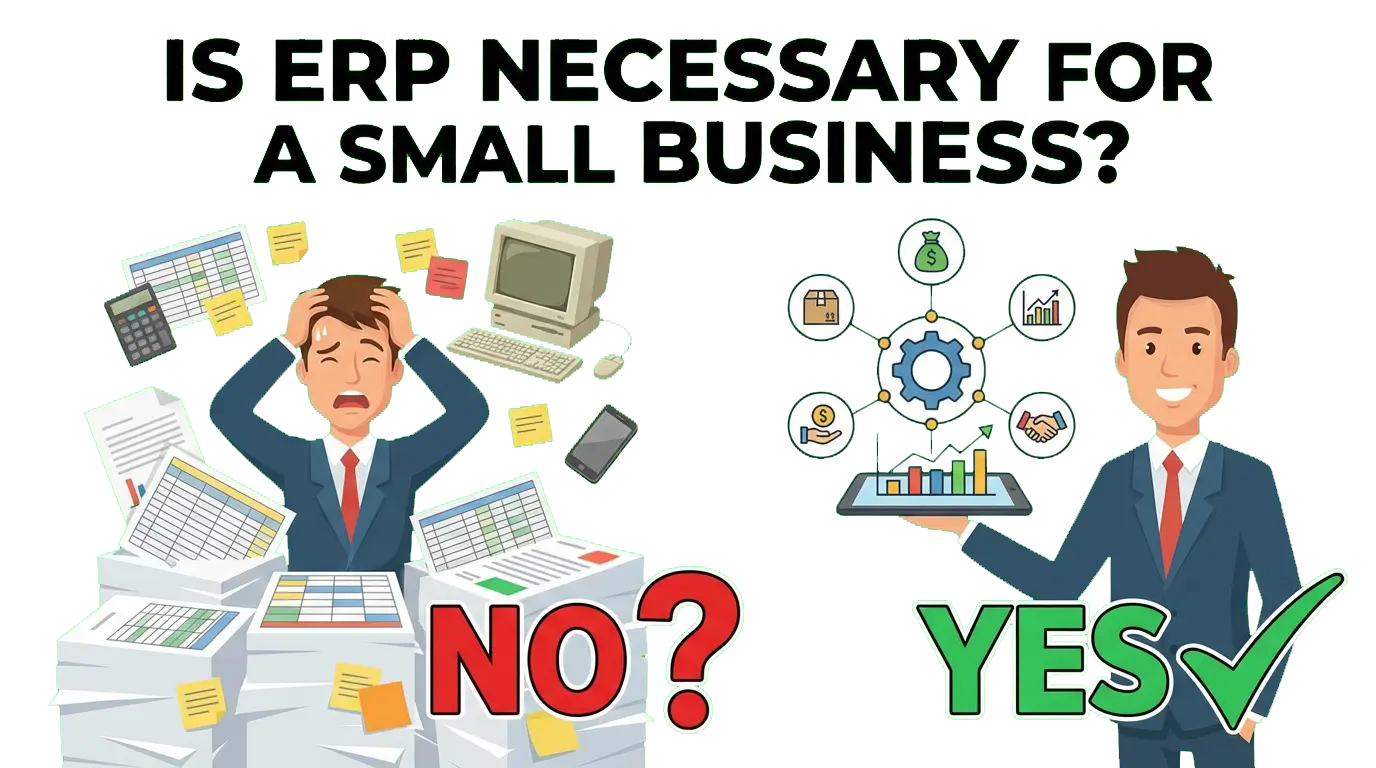
At the beginning of a business, everything can work “manually”: sales in Excel, inventory on paper, accounting in a separate program. But as operations grow, information becomes fragmented, and gathering numbers takes more time than making the decision itself. This is where the question arises: is ERP worth it for a small business?
The short answer: sometimes yes, sometimes no. The real difference is not the “size of the business,” but the complexity of its processes.
ERP (Enterprise Resource Planning) is a system that combines processes such as sales, procurement, inventory, finance, and reporting into one platform. The goal is simple: everyone works with the same data, workflows can be tracked, and repetitive operations are reduced.
For a small business, the most realistic gains from ERP are: - reduced data fragmentation, - increased control (who did what and when), - faster preparation of reports.

When Does a Small Business Need ERP?
The need for ERP usually reveals itself through signals like these:
1) The same information exists in multiple places. If customer data is scattered across phones, emails, and Excel, errors are inevitable.
2) Inventory and sales do not match. You say “stock is available” and sell, then discover it is not.
3) Reporting is delayed. If weekend “number gathering” has become routine, management becomes blind.
4) As work increases, chaos increases. A new employee joins, but without a standardized process, adaptation takes too long.
If several of these apply to you, your “fragmented tools” are already approaching their limit.
What Happens When ERP Solutions Are Chosen Incorrectly?
A similar scenario repeats itself here: the demo looks good, reality is difficult. The results of a wrong choice:
- budget inflation (modules, users, integrations)
- prolonged implementation (data migration and training)
- team resistance (complex interface, slow system)
- returning “back to Excel,”
- vendor dependency (without an exit plan, switching becomes expensive)
In other words, when the wrong choice is made among ERP solutions, you gain not “control,” but an “additional burden.”
Is ERP “Expensive,” or Just Poorly Calculated?
In small businesses, the most common objection is: “ERP is expensive.” In reality, what is often expensive is not the ERP itself, but the planning. The cost is not only the license; implementation (configuration), data migration, training, and ongoing support are also part of the package.
Two approaches help here: start with the minimum required scope (for example, only sales + inventory), then add modules as you see results. This way, risk decreases, and it becomes possible to align investment with revenue growth.
Correct ERP Solutions and Incorrect ERP Solutions: The Difference
| Area | Correct ERP Solutions | Incorrect ERP Solutions |
| Cost and time | phased implementation, clear budget | hidden costs, extended schedule |
| Data | unified database, fewer errors | duplicated data, inconsistent figures |
| User adoption | aligned with real workflows | “complex system,” low usage |
| Growth | scaling by adding modules | performance decline, reconstruction cost |
A Short Roadmap That Simplifies the Choice
Let’s keep it practical. These 5 steps solve a lot:
- Write the objective: What will ERP improve? (stock accuracy, order tracking, reporting speed, etc.)
- Start from the most painful area: not everything in one day.
- Ask about integration: How will it connect with the bank, POS, e-commerce, document flow?
- Build a training plan: It increases system adoption.
- Request an exit plan: The data should belong to you and be exportable if needed.
This approach ties the decision not to “preference,” but to business value — leading to the right ERP solutions.

ERP in Azerbaijan: Opportunities Exist, but the Approach Must Be Strategic
In Azerbaijan, both local and international ERP options are available, but precise adoption statistics by sector are not openly published.
Local recommendation: Check in advance compliance with tax and document workflow requirements, the availability of Azerbaijani language support, and the level of technical service. If internet stability is a risk, consider offline/hybrid scenarios as well.
If data is fragmented and management is built on “manual work,” ERP is no longer a luxury for a small business. Make the decision without rushing: first define the need, then reduce risks through a pilot/phased implementation. A correctly chosen ERP accelerates the business; an incorrectly chosen ERP exhausts it.